Home Charging 101 from Rivian
Waking up to a full charge every morning is one of the best things about owning an electric vehicle. It’s an important reason that EV owners rarely ever switch back to gas vehicles.*
Since over 80 percent of charging happens at home, it totally transforms how you think about fueling up.** Once you experience the benefits of home charging, you’ll probably never willingly go to the gas station again. It’s that great.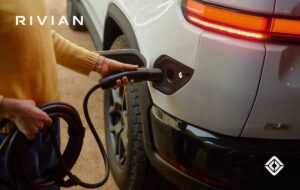
To make your EV transition as seamless as possible, there are some things you should know. We’ve put together this Rivian guide to home charging to answer common questions and help you get the most out of your Rivian from day one.
It starts with a plug.
Home charging means plugging your vehicle in right where you park it every night, so it will be ready to go whenever you need it. You’ll find that having a charger right in your driveway or garage is the ultimate convenience.
Different home charging setups will charge at different speeds, measured in kilowatts.*** Choose the charging setup that works best for your needs.
Rivian Wall Charger
For the fastest charging speeds at home, you can have a hard-wired home charger installed on a dedicated 60 amp circuit by a professional electrician. With the indoor/outdoor rated Rivian Wall Charger, you’ll be able to charge at 11kW, adding up to 25 miles of range per hour for R1T or R1S and 38 miles per hour for R2.
NEMA 14-50 240V outlet
Many owners choose to charge on an EV-rated 60 amp NEMA 14-50 240V outlet, which can achieve speeds around 9kW, adding about 16 miles of range per hour for R1T and R1S and 25 miles per hour for R2. While slower than a hardwired wall charger, this is a convenient, simple option for many garages.
Household 120V outlet
For situations where you just need a trickle charge, when you won’t be driving much or you just need topping up in a pinch, you can plug into a regular 120V household outlet, too, which will add around 3 miles of range per hour.
Whichever home charging setup you choose, we recommend hiring a licensed electrician to install the charger that’s best for your needs. Rivian is partnered with Qmerit and Treehouse to connect you with pros in your area. Also, be sure to check for local and state incentives for installing an EV charger in your home.
Charge when it’s best for you.
Setting a charge schedule lets you take advantage of lower off-peak electricity rates offered by many utilities. The Schedule Recommendation feature in the Rivian App can find the lowest-cost plans and times for EV charging from your provider, and suggest a charging schedule to match. If your off-peak times change on weekends, or by season, Schedule Recommendation automatically updates your charge windows. Whether you set your own, or use our smart charging features, easy off-peak scheduling helps you save money with every charge.
Set your charge limit.
Most people won’t need to use the full capacity of the battery every day. You can set your charge limit with the Energy App, accessible in the vehicle infotainment display and in the Rivian App. We recommend setting the charge limit to 70-80 percent for typical daily use and to 100% for longer trips. This helps maximize the longevity of the battery, but if you need a full charge on a regular basis, don’t worry! Your Rivian’s pack will happily eat up the miles.
Keep track of use with the Energy App.
The Energy App helps you customize, regulate and monitor your energy usage while charging and driving. See a breakdown of how your vehicle is using energy, view your charging history and get recommendations to increase your efficiency.
ABC: Always Be Charging.
Once you have your charger set up, plugging in becomes second nature. just plug in when you get home and wake up with a full charge. Charging your EV at home is simpler, cheaper and cleaner than going to a gas station every week.
Trust us, you won’t miss it.